The Fractional CAIO Hiring Checklist: 12 Questions to Ask Before You Sign

The right fractional CAIO hiring checklist comes down to twelve questions across four areas: what the person will actually build, how they handle your data and risk, who does the work, and what you keep when the engagement ends. Ask all twelve before you sign, because the gaps they expose are the same ones that sink most engagements. A strong fractional chief AI officer will welcome every question on this list — vague or defensive answers are the signal to keep looking.
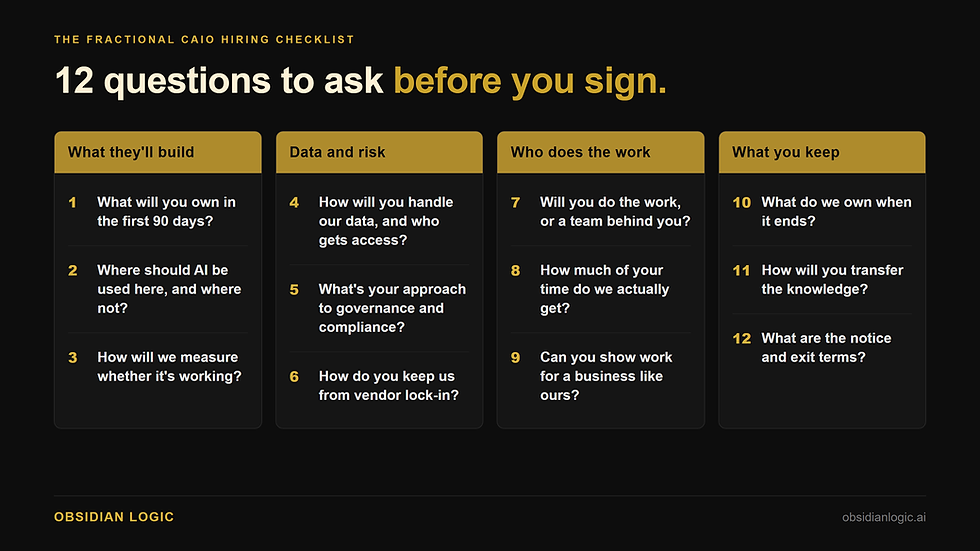
Most fractional CAIO engagements don't break down over talent. They break down over mismatched expectations: scope that was never pinned, a dependency no one planned to unwind, work handed to someone you never met. The questions below are built to catch those problems while you can still walk away.
What they'll actually build
1. What specific outcomes will you own in the first 90 days?
A strong answer is concrete and measurable — a prioritized roadmap, a set number of workflows automated, a named business metric to move. "We'll build your AI strategy" is not an outcome. You want to hear deliverables you could check off.
2. How do you decide where AI should — and shouldn't — be used in our business?
Look for a method, not enthusiasm. A good fractional chief AI officer assesses your actual workflows, applies a return threshold, and is comfortable telling you where AI is the wrong tool. Someone who thinks everything is an AI opportunity will cost you money.
3. How will you measure whether this is working?
The answer should tie to your business — hours recovered, cost removed, revenue influenced — agreed up front, not reported after the fact. Be wary of anyone who measures success in models deployed or tools adopted rather than results.
How they handle data, risk, and governance
4. How will you handle our data, and who gets access to it?
You want clear controls: data minimization, defined access, and a rule that sensitive information never goes into a third-party tool without review. If the answer is casual, that's a problem — especially in a regulated industry.
5. What's your approach to AI governance and compliance in our industry?
A credible hire knows the rules that apply to you, sets usage policies for your team, and keeps a human in the loop where the stakes are high. Governance should be part of the plan from day one, not an afterthought once something goes wrong.
6. How do you keep us from getting locked into a tool or vendor we can't leave?
The best answers favor portable, interoperable solutions, document the setup, and avoid building your operations on top of something only one vendor controls. Lock-in is one of the most expensive mistakes in this space, and a good fractional CAIO actively designs against it.
Who actually does the work
7. Who will actually be doing the work — you, or a team behind you?
Either can work, but you need to know. The person you vet should be the person you get, or you should meet the named team and understand who owns what. "Don't worry about that" is not an answer when it's your operations on the line.
8. How many other clients do you serve, and how much of your time do we actually get?
Fractional means shared, so ask for the real number. You want honest capacity, a defined cadence, and a way to reach them when something matters. Overbooked is worse than part-time.
9. Can you show me work you've done for a business like ours?
Ask for real examples and outcomes, and for references you can call. Credentials and conference talks are not evidence. What a business your size actually got out of the engagement is.
What you keep when it ends
10. What do we own when the engagement ends?
You should keep the documentation, the configurations, and the accounts — not a black box only they can operate. If leaving means everything stops working, you never really owned it.
11. How will you transfer knowledge so this sticks after you're gone?
A good engagement builds in training, written procedures, and a handoff plan from the start. The goal of hiring a fractional chief AI officer is to leave your team more capable, not more dependent.
12. What are the terms — notice, exit, and what happens to in-progress work?
Look for reasonable notice, a clean exit, and clarity on who owns work that's underway. The contract should make leaving straightforward. Anyone who makes the exit difficult is telling you something about the relationship.
Red flags to watch for

A few answers should stop you cold. Be cautious of anyone who promises a specific ROI number before they understand your business, treats every process as an AI opportunity, or can't clearly say who will do the work. Watch for a missing exit or handoff plan, a push toward a single tool they happen to resell, and a pitch built on hype and credentials instead of outcomes. And if they won't put scope, metrics, or terms in writing — or pressure you to decide on the spot — treat that as the answer.
None of these mean the person is bad at the work. They mean the engagement is likely to end the way most troubled ones do: with unclear results and a dependency you didn't sign up for. The twelve questions above are how you find that out before it costs you.
Before you start interviewing
The checklist works best when you already know your own priorities — which is harder than it sounds. If you can't yet say where AI would create the most value in your operations, that's the first thing to fix, because it shapes every answer you're listening for.
That's what our AI Operational Assessment is built for: a focused look at where AI and automation can recover real time and money in how you already work, so you walk into the hiring conversation knowing exactly what you need. Across our last three AI Operational Assessments we identified $352K in recoverable value, with $86K the biggest single find at one company, each in under 24 hours. And we back it: we'll identify at least 8 hours a week of recoverable time, or your money back.
Still deciding whether a dedicated role is even the right move? Our Fractional CTO vs. Fractional CAIO breakdown covers which role fits your business, and the Fractional Chief AI Officer page covers what the role includes once you decide to bring one in.
FAQ
What should I ask before hiring a fractional CAIO?
Focus your questions on four areas: what they'll actually build and own, how they handle your data and governance, who does the work and how available they are, and what you keep when the engagement ends. The twelve questions above cover each area. A strong candidate answers all of them concretely and welcomes the scrutiny.
How do I know if a fractional chief AI officer is any good?
Look for measurable outcomes tied to your business, a clear method for deciding where AI does and doesn't belong, real examples of work for businesses like yours, and references you can call. Be skeptical of anyone who leads with credentials or hype instead of results, or who treats every process as an AI opportunity.
What's the difference between a fractional CAIO and an AI consultant?
A fractional CAIO takes ongoing ownership of your AI strategy and adoption — roadmap, governance, measurement, and results over time. An AI consultant is typically engaged for a defined project or recommendation. If you want someone accountable for outcomes on an ongoing basis, you're hiring a fractional CAIO.
How long does a fractional CAIO engagement usually last?
It varies with the scope and your goals, but a good engagement has clear terms from the start — defined cadence, reasonable notice, and a clean exit. What matters more than the length is that you keep the documentation, configurations, and trained team when it ends, so the value stays with you.
What should I have ready before the first conversation?
Know your biggest operational pain points and where you think AI could help — and be honest about what you're unsure of. If you can't yet name where the value is, an AI Operational Assessment is a low-commitment way to get that clarity before you interview anyone.